
Barcodes & bulk materials?
PART 1 OF 3
What If We Could Put a Barcode on Every Ton of Bulk Material?
You don’t need a barcode. You need what a barcode does for every other industry.
Pickands Mather · 3 min read
Moving bulk material has always been a team game. Mines, terminals, railroads, vessels, and the end customers all depend on each other to get a shipment where it needs to go. As a long-standing trusted advisor inside bulk material supply chains, Pickands Mather has spent decades working between companies and managing the data between each layer of the supply chain. We believe the next real gain in efficiency won’t come from any one of them working harder. It will come from all of them working off the same, better-connected information.
Every package FedEx, UPS, and Amazon ships get scanned a dozen times or more between a warehouse shelf and a front porch. One barcode, printed once, gets read by a dozen systems belonging to different companies along the way.
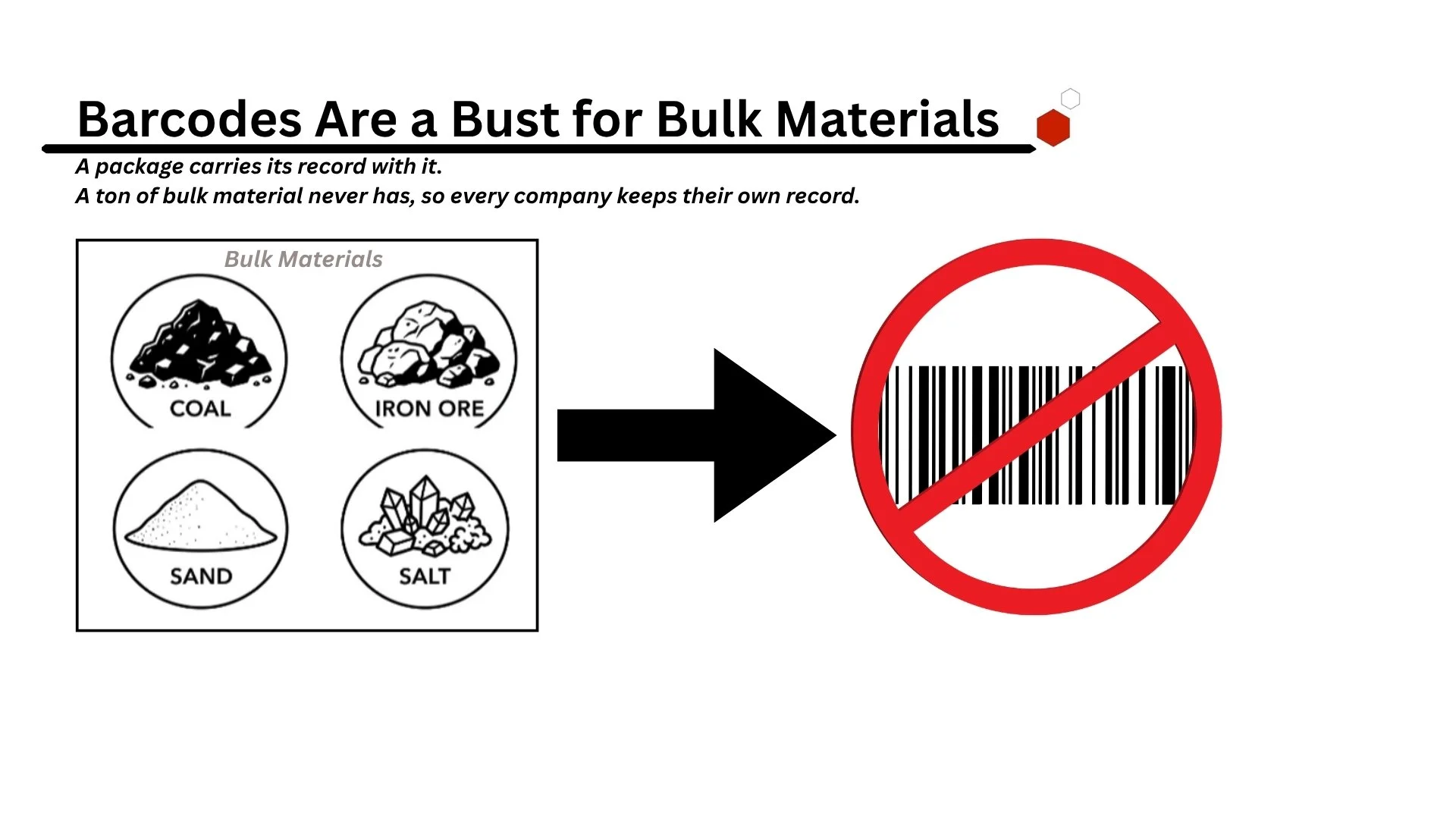
But you can’t put a barcode on a ton of coal, iron ore, or gravel. So bulk logistics has run on paper, email, phone calls, and scattered spreadsheets. That isn’t a knock on the industry, it is simply what worked in the past.
Picture a routine delivery. A truck crosses the scale at a terminal, a Bill of Lading gets created, and a copy gets emailed to whoever needs it next. Weeks later, when the invoice finally gets matched against that delivery, two departments are working from two different data trails, trying to confirm what actually took place. Nobody did anything wrong. The information just never lived anywhere both sides could see and utilize at the same time.
That’s what bulk material has been missing; not a scanner and a sticker, but a shared record that follows the shipment. Today a mine, a terminal, a railroad, a vessel, and the end customer each keep their own version of the truth, usually in a spreadsheet, sometimes only in someone’s memory. The same shipment gets keyed three or four times by three or four people, and the records are at risk of misaligning.
Match Tracks grew out of the issue of multiple records for the same piece of data. It gives every party to a shipment one shared record instead of four: what was agreed, what moved, and what’s owed, updated as it happens.
The shared data record is the replacement for the barcode in bulk materials.
Every data inaccuracy gets closed by hand, in hours nobody tracks re-keying, phone calls chasing a Bill of Lading, two accounting teams reconciling the same load after the fact. Multiply that across an entire supply chain and it adds up to something real. We call it a coordination tax, and the industry has paid it quietly for so long that most of the people paying it no longer notice.
The more interesting question is what happens when an entire supply chain, from producers and carriers to terminals and customers, decides that tax is no longer worth paying. Not one company solving it alone, but all of them working off the same data record. That’s the case we intend to make, one piece at a time.
NEXT IN THIS SERIES
We name what sits underneath that coordination tax and put a real number on what it has been costing the industry all along.